
When choosing ceramic anti-static flooring, the key points to consider are anti-static performance, load-bearing and wear resistance, ventilation and heat dissipation, adaptability, and manufacturer service, which can help you quickly find the right one.
1、 Core performance indicators
Anti static performance: The surface resistance should be stable within the range of 10 ⁶ -10 ⁹ Ω, and the system resistance should be between 10 ⁵ -10 ¹⁰ Ω to ensure effective conduction of static electricity.
Load bearing and wear resistance:
Load bearing capacity: required to be ≥ 500 kg/㎡, suitable for placing heavy equipment.
Wear resistance: A wear-resistant layer of aluminum oxide is added to the surface, with a Mohs hardness of 7 or above, suitable for high wear environments.
Ventilation and heat dissipation: It is recommended to have a ventilation rate of 20% -50%, with ventilation holes of sizes such as 10mm × 10mm or 15mm × 15mm, and to cooperate with air conditioning to form a "downward air supply" mode.
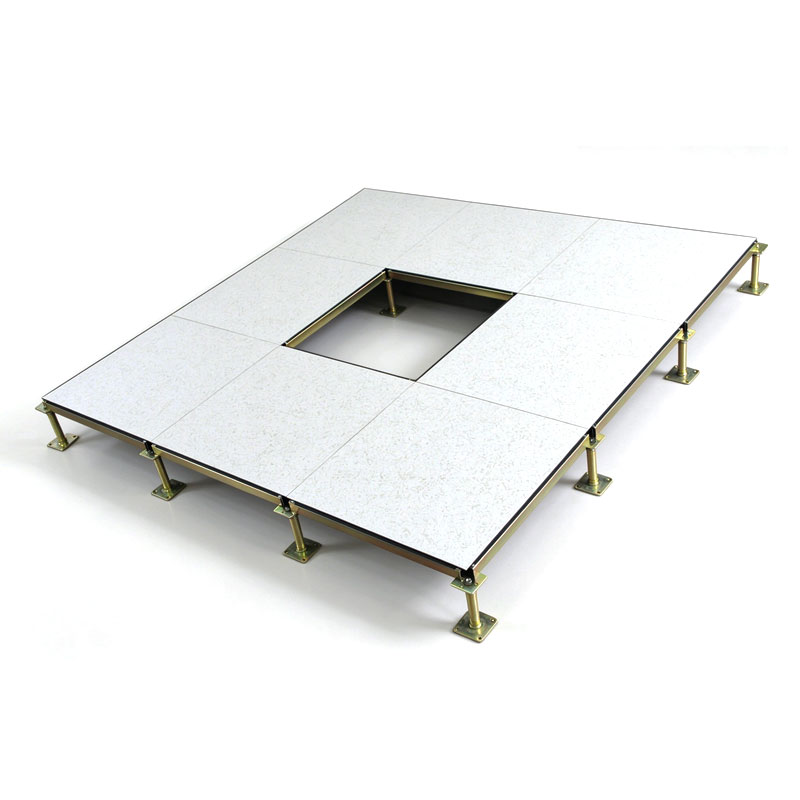
2、 Structure and adaptability
Thickness: 40mm-50mm is preferred, as being too thin can affect load-bearing capacity and stability.
Bracket system: It must be equipped with thickened brackets and crossbeams to ensure long-term stability.
Adaptability: Consider the size of ventilation holes, ventilation rate, floor color, and coordination with indoor decoration.
3、 Manufacturer selection and service
Technical strength: Prioritize manufacturers who have provided products for high demand scenarios such as data centers and semiconductor factories.
Testing report: It is required to provide a third-party organization's anti-static performance and environmental protection testing report.
Installation service: Choose a manufacturer that provides one-stop services from measurement, paving to debugging to avoid performance failure caused by improper installation.
4、 Cost considerations
Ceramic anti-static flooring: The initial cost is high, but it has good wear resistance, fire resistance, moisture resistance, long service life, and is suitable for heavy equipment or harsh environments.
HPL anti-static flooring: lightweight, easy to install, and cost-effective, but its wear resistance and fire resistance are usually lower than ceramic flooring, making it suitable for small and medium-sized computer rooms or conventional electronic areas.
5、 Purchase process
Accurate measurement: Calculate the floor area of the computer room, convert the total floor area (or number of blocks) required, and count the number of accessories such as beams, adjustable supports, screws, etc.
Leave sufficient margin: It is recommended to reserve 5% -10% margin to cope with construction cutting losses and subsequent maintenance and replacement.
Sample testing: The manufacturer is required to provide samples and measure the surface resistance of the floor with a multimeter to ensure that the data is within the standard range.
6、 Precautions
Avoid hollow shell noise: If there is a hollow shell noise when knocking on various parts of the floor, it may indicate internal cracking and damage, and should not be selected.
Check flatness: The floor surface should be flat, with diagonal lines consistent, to avoid uneven gaps after installation.